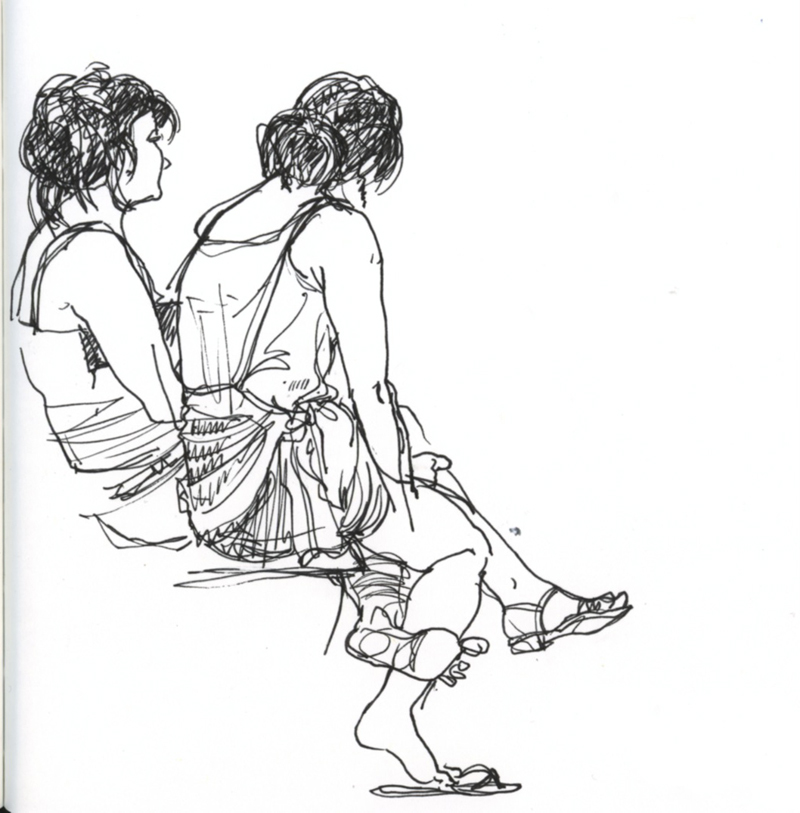
“I am so afraid I do not know what to do, I wish I was more careful, what got into me really?” troubled young woman in Kenya.
Last night I went to visit my friend who had just given birth to a beautiful baby girl. Since the hospital was on the other side of the town, the bus took a long time to get to the central business district. It had rained heavily, flooding parts of town. Despite getting drenched, or perhaps because of, my small umbrella, I decided to go to a nearby fast food restaurant to eat. I was sure I wanted take away to go eat from home
 but when I found an empty table upstairs I begun eating my garden salad with grilled chicken. Sitting beside my table were two young women in their early twenties. They were excited and speaking in high tones, having fun. Sitting there alone munching my food I could not help but overhear their juicy conversation. It felt bad to know that I was eavesdropping on their discussion, however I kept listening.
They are both local university students. One is dating a rich man who has decided to buy her a car and she is very excited about. In the middle of the conversation, she whispered, “What do you think I should do about the pregnancy?”. Let’s call them Abby and Ally. Abby is pregnant and about to receive a car from this man. She is excited but at the same time afraid because she is not sure what to do with her unplanned pregnancy. Ally told her, “I know that nurse in Kariobangi (one of Kenya’s urban informal settlements) who will help us. She helped so many other girls.”
“Is it safe?” Abby asked. “I am not sure,” says Ally, “however it is the best option since we cannot go to other hospitals. If you tell Abel (Abby’s rich male friend) he will not accept responsibility and will not buy you the car.” From the side of my eye I could see how afraid and shaken Abby was. In a low tone she asks, “What if I die in the process? What will happen to me? Do I have any options? Why wasn’t I careful? How can I continue with my studies? Am I a bad person? What will happen to me if I decide to keep it?”
Sitting there I thought to myself, this is one of the many lived realities of young women and girls in Kenya. With lack of access to information and services about their sexual and reproductive health and rights, many of them make bad choices in such circumstances and end up losing their lives from unsafe abortions.
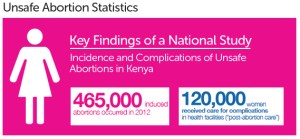 Statistics indicate that 29,000 abortions happen every year in Sub-Saharan Africa – translating to over 79 deaths every day. These lives can be saved. According to a 2012 study by the African Population and Health Research Center and its partners, in collaboration with Ipas and the Guttmacher Institute, found that nearly 465,000 induced abortions occurred in Kenya in 2012 – translating to a high national abortion rate of 48 a per 1,000 women of reproductive age (15-49 years). The findings also revealed that complications from unsafe abortions continue to pose a serious threat to Kenyan women’s health: nearly 120,000 women received care in health facilities for complications resulting from unsafe abortions in 2012. More shocking is that, young women suffered disproportionately, 45 percent of women aged 19 and younger who went to a health facility for post-abortion care has experienced severe complications.
With a constitution that allows abortion only to save a woman’s life, and when performed by a health professional, many young women still lack access to safe abortion care services and information. If people do not start speaking out about these issues, many young women and girls like Abby will continue losing their lives. If we do not demand action from the duty bearers, then we will continue having these gruesome statistics. The journey to change these realities and findings needs to start early, during adolescence. Abby’s life and many other women and girls in the same situation need to be saved, that is #whySHEmatters #WhatNereaShouldKnow.
Esther Kimani: Twitter; @kelsiekim, Facebook; Keslie Kim
 Unfiltered